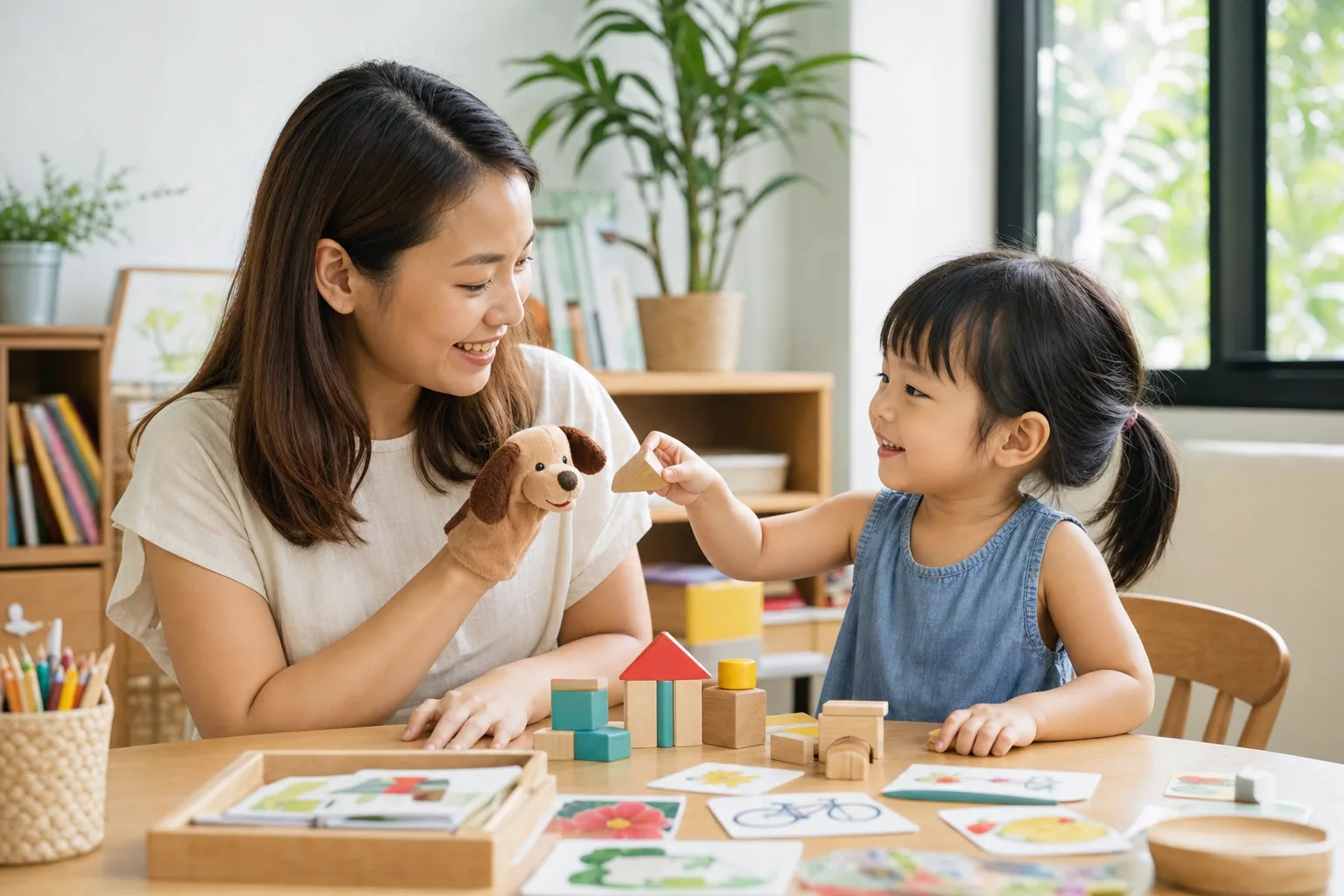
A puppet creates just enough distance for a child to try a new voice, retell an experience or explore a difficult feeling. The value comes from the conversation and invention around it, not from an elaborate toy.
How to choose and use puppet play
Language and storytelling
Children practise sequence, dialogue and perspective while making a character speak. Adults can model richer language without interrupting the flow of play.
Build a story one turn at a time
Begin with a place, a character and one small problem: a puppet has lost a sock, feels nervous about school or wants to join a game. Take turns adding one event. The child must listen to the previous event before adding the next one, so play naturally exercises attention and story sequence. If the child pauses, offer two possible actions instead of taking over. Later, ask for a beginning, middle and ending in the child's own words.
- Repeat one useful new word during the scene.
- Let the puppet make a mistake the child can correct.
- Record only with the child's permission.
For the next step, choose preschool resources.
Social rehearsal
A puppet can take turns, misunderstand, apologise and solve a problem. This lets children examine social situations with less pressure. How a child plays these scenes also reflects temperament, relationships and environment.
Use characters to explore feelings safely
Children may find it easier to advise a worried bear than to describe their own worry. Keep the situation gentle and do not use the puppet to force a confession. Ask, “What might this character be feeling?” and “What could a friend do?” Several answers can be reasonable. This develops perspective-taking because the child connects an action, a feeling and a possible response. End with repair or help rather than a lecture about the correct emotion.
- Name feelings without labelling the child.
- Model an apology that includes a helpful action.
- Stop if the scene becomes uncomfortable.
For the next step, compare early language activities.
Try a five-minute scene
Choose one character and one simple problem. Let the child direct the ending, then retell the story together. A sock, paper bag or wooden spoon works.
Make a reusable five-minute routine
Keep a small bag with two puppets and three prompt cards: a place, a feeling and a problem. Draw one card from each group and play for five minutes. On another day, replay the same problem with a different ending. Repetition helps a young child gain control over language, while the changed ending keeps the task creative. Adults can observe whether the child starts conversations, follows a sequence and adapts an idea without turning play into a formal test.
- Use socks, spoons or folded paper.
- Finish while the child still wants more.
- Retell the favourite scene at bedtime.
For the next step, find age-matched materials.
Match the puppet activity to what you want to build
A puppet is a tool, not a toy box. Pick the activity that fits the skill you are trying to grow this week.
| What you want to build | Try this | What you should see |
|---|---|---|
| Vocabulary | The puppet asks your child to describe a hidden object | New words used, not just recognised |
| Confidence speaking | The puppet interviews your child about their day | Longer answers than usual, less hesitation |
| Handling a worry | Act out the situation with the puppet first | Your child suggests what the puppet should do |
| Listening | The puppet gives a two-step instruction | Both steps followed without a reminder |
Build your own plan
Name one need for this topic, select the most useful part of the guide and describe the evidence you will review. The note stays in your browser and sends no student information to OpenSchoolbag.
This page supports education decisions in the area covered above. It cannot guarantee admission, examination results or product availability; changing claims need a current source.